
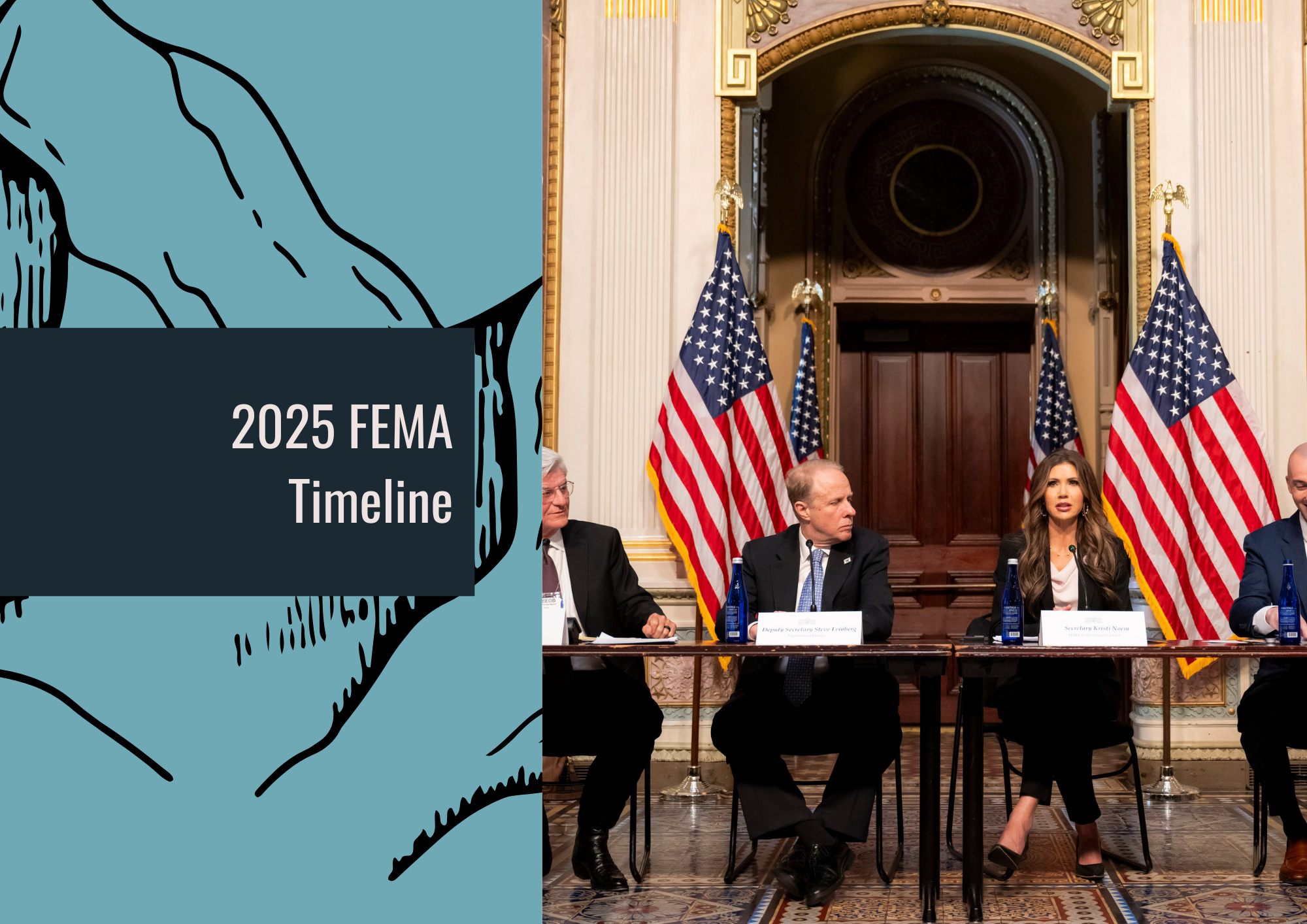
President Trump’s inauguration heralded a year of rapid changes. On his first day in office, Trump created the Department of Government Efficiency (DOGE) to implement his agenda of downsizing the federal government. Under Elon Musk’s leadership, DOGE haphazardly reduced the federal workforce and cut spending. As a result, these actions hampered many agencies' ability to fulfill their duties. Despite FEMA’s critical role, it was a target for significant changes
From the beginning of 2025, the Trump administration clearly communicated its desire to drastically overhaul FEMA. At the start of the year, Trump proposed the idea of entirely dismantling FEMA. Although his administration did not eliminate it, Trump convened a special council to critically review the agency. Under former Secretary of Homeland Security Kristi Noem, FEMA was guided by a leader aligned with Trump’s ultimate goal to “dismantle the government bureaucracy.” Trump’s objective resulted in attempts to end grant programs, claw back obligated funds, and create barriers to accessing support.
The following timeline details key administrative, legislative, and legal milestones that illustrate FEMA’s changes in 2025. Read the full report here.
Policy
Impact
Jan. 20
Jan. 24
Mar. 19
May 20
President Trump issues Executive Order 14159: “Protecting the American People Against Invasion” to withhold federal funding from sanctuary jurisdictions
This Executive Order leverages federal assistance to force states to comply with its immigration agenda. FEMA funds may not be granted freely, depending on a state’s immigration agenda.
Mar. 25
Trump issues Executive Order 14180: “Council to Assess the Federal Emergency Management Agency.”
President Trump issues Executive Order 14247: “Modernizing Payments To and From America’s Bank Account,” which eliminates paper-based transactions with the U.S. General Fund.
A federal judge rules in favor of the states in the State of Washington v. Federal Emergency Management Agency.
The order mandates a council to conduct research and propose changes. It signals the administration’s intention to “drastically” change the agency’s current structure.
Feb. 26
Mar. 25
Mar. 27
Apr. 04
May 13
June 18
July 16
July 23
Politico reports a leaked memo that directs the agency to remove phrases referencing climate change and equity.
FEMA announces that it will no longer enforce the Federal Flood Risk Management Standard Policy.
FEMA announces that it will terminate the Building Resilient Infrastructure and Communities program (BRIC).
The document forbids words such as “climate,” “green,“ “carbon footprint,” “climate resilience,” and “inclusion,” indicating that FEMA will no longer consider these topics in its policies and projects.
May 08
President Trump issues Executive Order 14239: “Achieving Efficiency Through State and Local Preparedness.”
DHS issues Fiscal Year 2025 Standard Terms and Conditions, incorporating new requirements regarding grant recipients’ immigration policies and DEI programs.
The Trump-appointed FEMA Acting Administrator, Cameron Hamilton, is dismissed after his congressional testimony supporting FEMA.
The FEMA Review Council convened for the first time, establishing a report deadline of December 11.
Twenty states file State of Washington v. Federal Emergency Management Agency.
The FEMA Act of 2025 is introduced in the House of Representatives. The legislation would significantly alter the agency’s organizational structure and assistance programs.
While signaling a shift toward state and local leadership in disaster response, the order primarily serves as a directive for the Assistant to the President for National Security Affairs and the Department of Homeland Security to review and revise policies on critical infrastructure, national continuity, and disaster preparedness and response.
Originally, the policy required federally funded flood repairs to meet higher elevation and resiliency standards. Without enforcement, projects are vulnerable to future disasters and will incur higher long-term repair costs.
This Executive Order creates additional barriers for individuals lacking reliable internet access. According to the Appalachian Regional Commission, 18.8% of households in the region lack broadband access. Without physical checks, these families face significant hurdles in accessing FEMA or disaster recovery funds during future emergencies.
The update formalizes specific compliance benchmarks that local communities must meet to access FEMA funding. This move significantly increases the administrative and political criteria for securing federal disaster grants.
A coalition of 20 states files State of Illinois et al. v. Federal Emergency Management Agency et al.
The administration intends to rescind $882 million previously allocated for hazard mitigation. They effectively de-obligate funding for infrastructure projects designed to mitigate the impact of future disasters.
This departure indicates political tension within the agency. In a later interview, Hamilton recounts a “hostile relationship” between DHS officials and himself during his tenure. Hamilton is replaced by the Assistant Secretary at the DHS’s Office for Countering Weapons of Mass Destruction, David Richardson.
This coalition legally challenges the Trump administration’s decision to withhold funding for immigration “sanctuary jurisdictions.”
Secretary Noem requires every contract or grant over $100,000 to be personally reviewed by her.
The committee's partisan composition and its intention to fundamentally restructure FEMA underscore the significant shift in the agency’s direction this year.
This policy introduces an administrative bottleneck in the funding process. Officials within FEMA warn that this action could slow response times during natural disasters.
This legal action aims to block the cancellation of the Building Resilient Infrastructure and Communities (BRIC) program.
This bill would increase FEMA’s independence from DHS and improve the delivery of post-disaster assistance. It reflects a different philosophy for the agency's future than the Trump administration's vision.
Aug. 20
Sept. 03
Sept. 24
Sept. 29
FEMA requires disaster survivors to have an email address to receive individual assistance.
The FEMA Act of 2025 passes through the Committee on Transportation and Infrastructure with a bipartisan 57-3 vote.
A U.S. District Court judge grants a motion for summary judgment in the State of Illinois v. Federal Emergency Management Agency.
Eleven states sue DHS and FEMA, after substantial decreases in funding for the Homeland Security Grant Program and the Emergency Management Performance Grant Program in the State of Illinois v. Noem.
This policy further limits aid to vulnerable individuals who may lack internet access or struggle to use technology.
This legislative action illustrates Congressional support for FEMA reforms that strengthen the agency, not total deconstruction of it.
The judge ruled that FEMA’s decision to withhold funding from states that do not comply with its immigration agenda was illegal. The ruling ordered FEMA to restore funding levels to previous levels, before the reduction based on immigration policy. FEMA appealed the ruling on November 21, 2025, but the ruling currently protects billions of dollars in state funding. The appeal is still pending as of the report publication on May 1, 2026.
The states claim that FEMA decreased funding decisions because the states refused to use their local law enforcement to assist with federal immigration enforcement.
Sept. 30
Oct. 01
Nov. 04
FEMA releases Emergency Management Performance Grant and Homeland Security Grant Program funding award notices, containing shortened performance periods and adding requirements for States to certify their population.
Congress begins the longest government shutdown in U.S. history, spanning 43 days.
Twelve states file State of Michigan v. Noem, alleging that the Trump Administration violated the Administrative Procedure Act through its September 30 grant rule changes.
The award notice attempts to limit the scope of projects eligible for funding by imposing shorter performance periods. The population certification also serves as a bureaucratic hurdle to states' access to funding.
FEMA employees do not receive a paycheck during this time, and 3,950 employees are furloughed. “Nonessential” programs are suspended in the shutdown, and authorization for the National Flood Insurance Program (NFIP) expired without an extension, restricting the ability to. issue or renew policies. This program was implemented to provide government-backed flood insurance to communities that opt in to implement national flood management standards. Without the NFIP, homebuyers must enter the private flood insurance market, which is often more costly to consumers, more likely to deny coverage, and less accountable to the public during disasters. Consumers must agree to less favorable terms or stall real estate purchases in flood-prone regions.
The lawsuit challenges the shortened performance periods and the new population certification requirements. The states argue that the administration is unlawfully creating administrative barriers to withhold funds, exceeding the executive branch’s authority.
Nov. 17
Dec. 11
FEMA Acting Chief David Richardson resigns.
The FEMA Review Council cancels its highly anticipated report release without providing a reason for the cancellation.
He is succeeded by FEMA Chief of Staff Karen Evans, who will be the third Acting Chief of FEMA for 2025. Richardson was highly criticized for his nonresponsiveness after the Central Texas Flooding that devastated a girls’ summer camp.
Dec. 22
A federal judge rules that the Homeland Security Grant Program (HGSP) and Emergency Management Performance Grant (EMPG) allocations in the State of Illinois v. Noem were unlawful.
The absence of these findings leaves the agency’s long-term plans undefined, creating uncertainty for state and local disaster mitigation efforts.
This reverses the termination of the Building Resilient Infrastructure and Communities Program and orders the release of the funds. In March 2026, the court granted the plaintiffs’ motion to enforce the judgment, finding that FEMA had not taken substantial steps to comply with the order. The case remains ongoing as of May 1, 2026, as reflected in subsequent FEMA’s status reports, ensuring the agency’s compliance.
The court orders that the original funding levels be restored and strikes down the immigration compliance requirements. The judge notes that shifting funding "based solely on what appear to be Defendants’ political whims is unconscionable and, at least here, unlawful." This ruling halts the administration's attempt to use emergency preparedness grants as leverage for immigration enforcement. On February 20, 2026, FEMA filed an appeal, and this case is still ongoing.
Dec. 23
States gain another legal victory against the Trump Administration, as a federal district judge ruled in favor of the states in the State of Michigan v. Noem.
The court found that the shortened performance periods and population certification requirements for HGSP and EMPG grants were illegal. On February 20, 2026, the Trump Administration filed an appeal, and the case remains ongoing.