
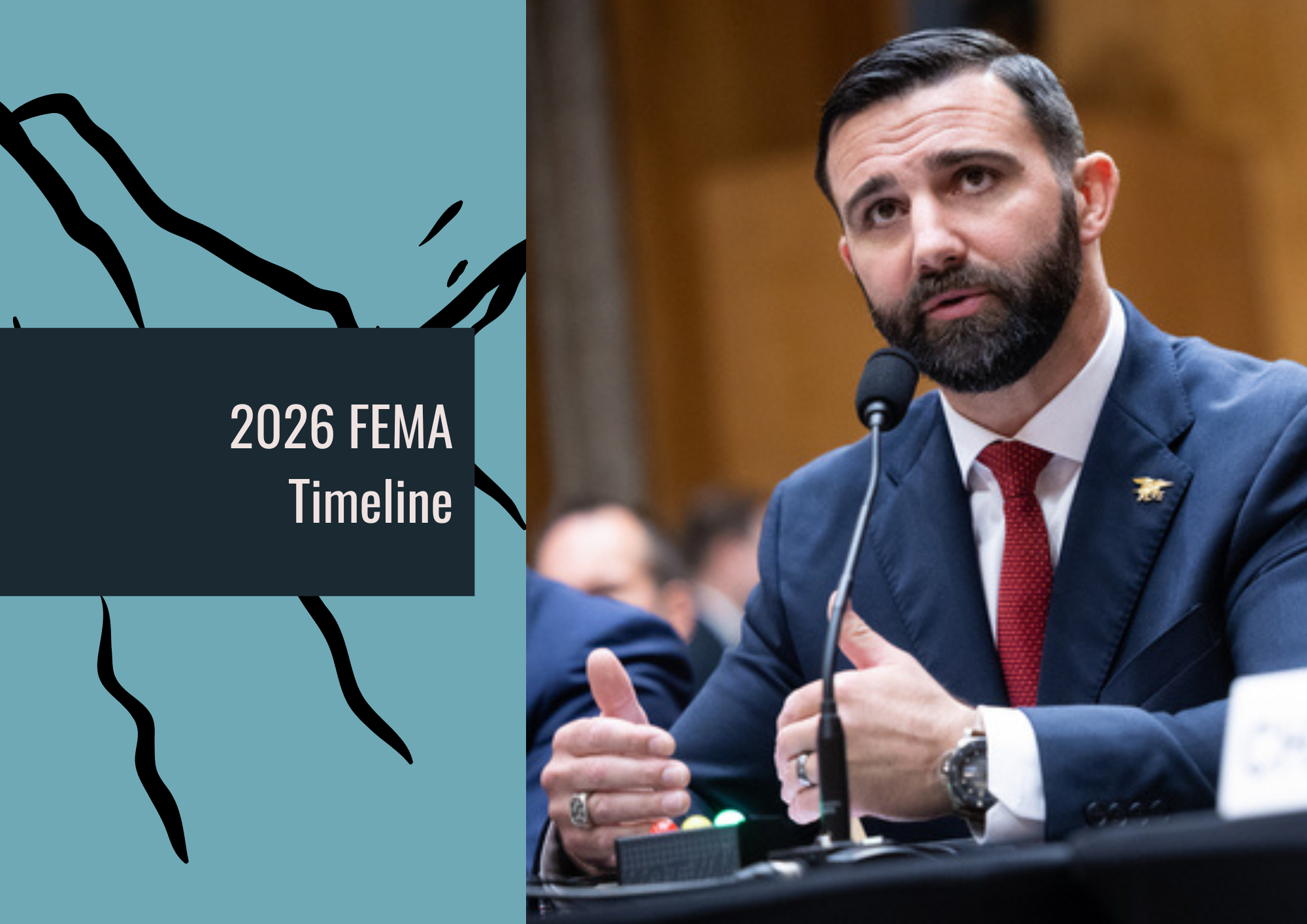
The uncertainty surrounding the scope and role of the Federal Emergency Management Agency (FEMA) continued from 2025 into 2026. Court disputes over mitigation funding remained unresolved, staffing reductions resumed, agency leadership changed again, and communities reported continued delays in receiving previously awarded disaster-resilience funds.
During the first half of the year, Congress, federal courts, and the Trump Administration took competing approaches to FEMA and disaster policy. Courts pressed the agency to restore the Building Resilient Infrastructure and Communities (BRIC) program, while the administration continued reducing FEMA’s workforce and changing the requirements governing federal disaster assistance. Congress separately considered proposals to protect disaster funding and establish a permanent disaster-recovery program through the Department of Housing and Urban Development (HUD).
By August, a Government Accountability Office (GAO) review concluded that FEMA faced critically low staffing levels and lacked the strategic workforce planning needed to carry out its mission. This timeline tracks the major FEMA policy, funding, staffing, and leadership developments reported during 2026..
Policy
Impact
Feb. 06
May 12
Feb. 09
North Carolina joins 22 other states in asking a federal court to enforce an earlier ruling requiring FEMA to restore funding for BRIC projects.
Jan. 30
Feb. 20
Mar. 20
Mar. 30
May 31
June 17
Reporting on the federal response to a major winter storm describes an increasingly-strained relationship between Department of Homeland Security (DHS) leadership and FEMA. The account portrays Secretary Noem as treating the agency as an adversary, even as FEMA personnel were coordinating response to the storm.
FEMA managers report workforce reductions that were paused during the January winter storm will resume. The reductions may affect Cadre of On-Call Response/Recovery Employees (CORE).
FEMA tells states that it is restarting BRIC under court order. In the same communication, the agency repeats the administration’s criticism that the program had become overly focused on climate-change initiatives.
The storm itself tested FEMA while its authority, staffing, and relationship with DHS leadership were already unsettled. Disputes within the department risk distracting agency leaders at the moment they need to make quick operational decisions and support state and local emergency managers.
May 07
Members of Congress consider a separate funding measure for FEMA’s disaster-assistance and mitigation programs as negotiations over broader DHS funding remain stalled.
The presidential FEMA Review Council releases its final report, completing a review of the federal government’s role in disaster response and recovery.
Acting FEMA Administrator Karen Evans is removed after leading the agency since December, resulting in another leadership transition.
FEMA enters the Atlantic hurricane season with a workforce nearly 20 percent smaller than it was at the start of the Trump Administration.
At Cameron Hamilton’s Senate confirmation hearing, lawmakers question whether the administration has handled disaster-declaration requests consistently across states.
A separate appropriation could allow FEMA to continue paying for disaster recovery and mitigation work during a DHS shutdown. Without additional funding, the agency could keep responding to disasters, but it would have less flexibility as the Disaster Relief Fund (about $7 billion at the end of January) continued to decline.
More than 10,000 CORE employees make up nearly half of FEMA’s workforce and perform much of the agency’s response and recovery work. Further reductions would leave FEMA with fewer experienced supervisors and less institutional knowledge during response and recovery operations.
The dispute leaves more than 2,000 mitigation projects awaiting federal funding nationwide. About $200 million in previously awarded grants remains at stake in North Carolina, delaying work intended to protect homes, infrastructure, and communities from future disasters.
The announcement reverses the agency’s attempt to end BRIC, but it does not immediately resolve when communities will receive their awards. Local governments must continue planning projects, managing contracts, and covering costs while they wait for FEMA to release the money.
New reporting and call data challenge FEMA leadership’s statement that the “vast majority” of calls from survivors of the Texas floods were answered.
Communities with approved projects still lack certainty about which grants will move forward and when reimbursements will arrive. The disruption is particularly consequential for places with limited local capacity and high exposure to flooding, wildfire, and other hazards.
The council recommends shifting more financial and operational responsibility to state and local governments while narrowing and streamlining the federal role. Such a shift would have the greatest consequences for jurisdictions with limited staff, revenue, or administrative capacity to manage large disasters without extensive federal support.
The records indicate that most callers did not reach an agency representative. For survivors seeking shelter information, registration assistance, or updates on federal aid, an unanswered call can delay access to help during the first days of recovery.
The Trump Administration moves forward with Cameron Hamilton as its nominee to lead FEMA. Hamilton previously served as acting administrator and was removed in 2025 after telling Congress that eliminating FEMA would not serve the public interest.
Evans was the third acting administrator to leave the role, forcing agency staff and state partners to adjust to another leadership change just before hurricane season. The turnover requires FEMA staff and state partners to adjust repeatedly to new leadership while the agency is also managing staffing cuts, unresolved grant disputes, and preparations for hurricane season.
The nomination indicates that the administration intends to retain FEMA, although questions remain about the agency’s future responsibilities. Hamilton would also inherit a growing backlog of disaster-declaration requests: 19 were reportedly pending at the time of his nomination, compared with nine on the same date in 2024 and four in 2023.
A smaller workforce means fewer employees are available to deploy to new disasters while other teams continue managing long-term recovery, survivor assistance, public-assistance projects, and mitigation grants. Multiple major disasters occurring close together would place the greatest pressure on that reduced staff.
Disaster declarations determine whether communities can obtain major forms of FEMA assistance. Questions about delays or political influence therefore affect more than the agency’s reputation: governors, local officials, and survivors may be left waiting for federal help while recovery costs continue to accumulate.
June 18
June 23
June 24
July 6-8
The Department of Homeland Security (DHS) announces requirements directing recipients of federal disaster assistance to avoid practices that unintentionally discriminate. The department continues to prohibit intentional discrimination.
Congress approves legislation converting HUD disaster-recovery assistance from a program funded through occasional special appropriations into a standing program with an annual budget.
Reporting finds that National Weather Service (NWS) staffing shortages are affecting severe-weather forecasting and warning operations following federal workforce reductions.
The change narrows the circumstances in which a disaster-aid policy may be challenged under DHS civil-rights regulations. A rule that appears neutral may now receive less scrutiny even when its design produces unequal results for different racial or ethnic groups.
The bill would give states, landowners, and local organizations additional ways to finance drought, watershed, forest, and wildfire projects outside FEMA’s grant programs. It would also establish new conservation-assistance and forest-easement programs, potentially broadening the federal resources available for work that reduces disaster risk before an emergency occurs.
A permanent program would give communities a more predictable source of support for housing, businesses, and infrastructure not fully covered by FEMA or Small Business Administration assistance. The legislation also directs at least 70 percent of the funding received by state and local governments to low- and moderate-income households and communities.
FEMA and local emergency managers depend on National Weather Service forecasts to decide when to issue warnings, open emergency operations centers, position response teams, and prepare shelters. Gaps in forecasting coverage may leave officials with less time to act, particularly in Appalachian communities where flash flooding can develop rapidly.
Aug. 05
Aug. 07
The GAO finds that FEMA may not have enough staff to carry out its mission. GAO recommends that the agency adopt a new strategic plan, analyze its workforce needs, and base annual staffing decisions on a broader workforce plan. DHS agrees with the recommendations but provides no dates for completing them.
FEMA’s workforce declined from about 26,000 employees in January 2025 to 20,400, a 22 percent drop. GAO linked the decline to the hiring freeze, employee buyouts, dismissals of probationary staff, and decisions not to renew some temporary appointments.
FEMA officials told investigators that the departures cost the agency experienced staff and institutional knowledge. GAO also found that FEMA eliminated its strategic plan without first determining how many employees—and what skills—it needed to carry out its mission.
The U.S. Senate confirms Cameron Hamilton to serve as the permanent administrator of FEMA. The confirmation passed with a 51–47 vote
Cameron Hamilton’s confirmation gives FEMA its first permanent leader in more than a year, providing greater stability and authority to implement long-awaited reforms. His tenure is expected to advance a federal disaster policy that streamlines aid while shifting more responsibility to states and focusing federal resources on the nation’s most severe disasters.